Choose timezone
Your profile timezone:
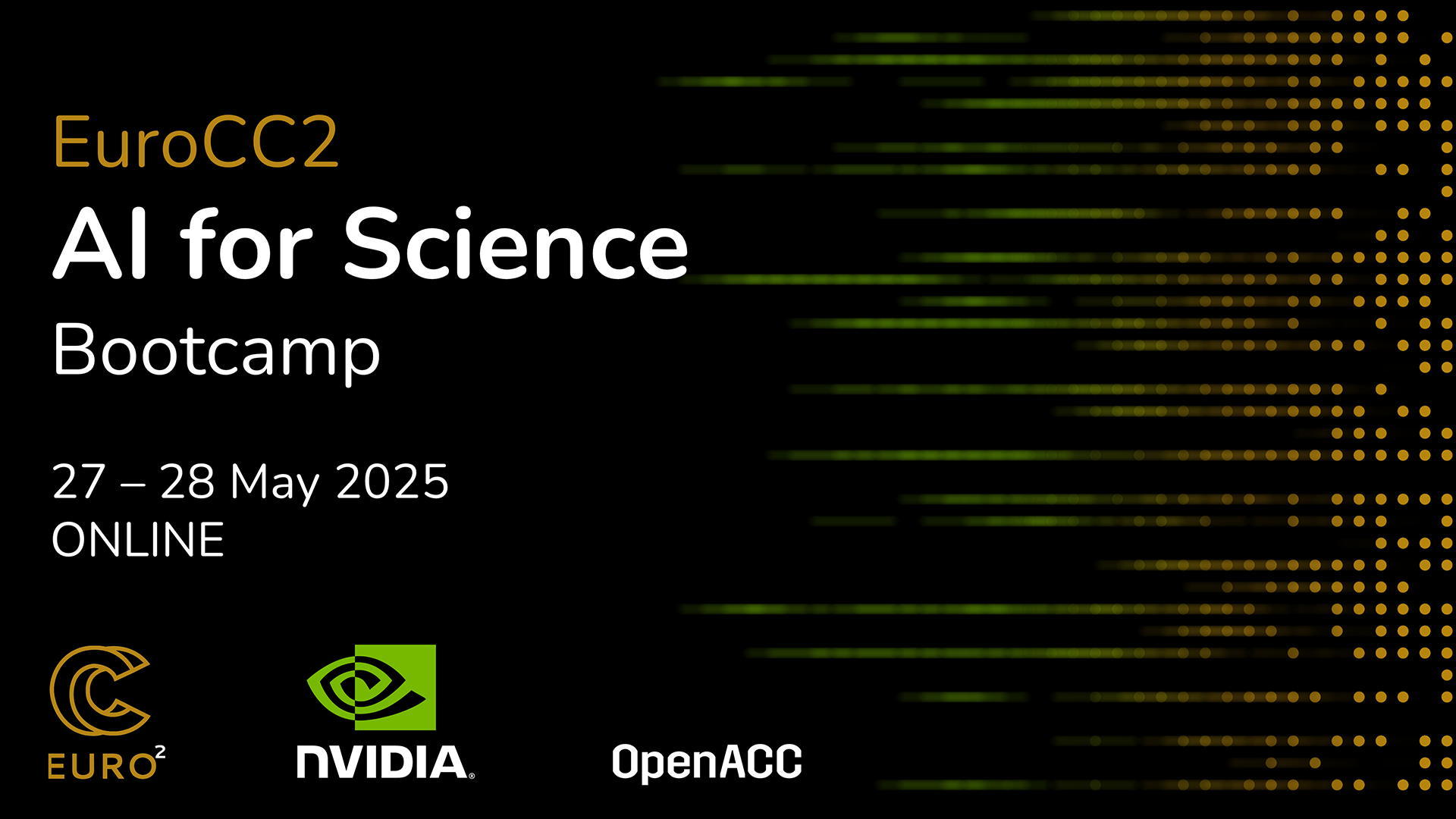
The End-to-End AI for Science Bootcamp provides a step-by-step overview of the fundamentals of deep neural networks, walks attendees through the hands-on experience of building and improving deep learning models using a framework that uses the fundamental laws of physics to model the behavior of complex systems (physics-informed neural networks – PINNs), and enables attendees to visualize the outputs of the trained model.
This online bootcamp is a hands-on learning experience where you will be guided through step-by-step instructions with teaching assistants on hand to help throughout.
This bootcamp, which will be hosted virtually for two half-days on May 27–28, is co-organized by the Vienna Scientific Cluster (VSC), IT4Innovations National Supercomputing Center (IT4I), High-Performance Computing Center Stuttgart (HLRS), Jülich Supercomputing Centre (JSC), Leibniz Supercomputing Centre (LRZ), University of Donja Gorica (UDG), Academic Computer Centre Cyfronet AGH (Cyfronet), Linköping University (LiU), Research Institutes of Sweden (RISE), HPC Vega at IZUM (IZUM), OpenACC organization, and NVIDIA, for EuroCC Austria, EuroCC Czechia, EuroCC@GCS, EuroCC Montenegro, EuroCC Poland, EuroCC Sweden, and EuroCC Slovenia, all National Competence Centres for High-Performance Computing.
Please ensure you meet all prerequisites / eligibility before you apply.
See Agenda & Content in the left menu for a detailed timetable and course content.
The registration for this training event is managed through the EuroCC AI for Science Bootcamp page on openhackathons.org.
Please note that for this event the application deadline is 25 April 2025. You will be informed until 06 May 2025 about your acceptance for the bootcamp.
If the number of registrations has reached its maximum, registration might close even before the deadline (and will open again if there are cancellations).
Please register with your official email address to prove your affiliation.
Following your successful registration, you will receive further information approximately 1 week before the course.
Content level: Basic = (100%) + Intermediate = (0%) + Advanced = (0%)
English
Basic – no prior GPU programming knowledge is required
Mathematical background in differential equations, python proficiency, and familiarity with deep learning fundamentals and frameworks are required.
Course for academia, industry, and public administration.
Attendees will be given access to an A100 GPU on one of the supercomputers of the organizers.
Event Moderator: TBD
Instructor: Niki Andreas Loppi (NVIDIA)
Teaching assistants and cluster support from the participating HPC centres:

This course is jointly organized by the Vienna Scientific Cluster (VSC), IT4Innovations National Supercomputing Center (IT4I), High-Performance Computing Center Stuttgart (HLRS), Jülich Supercomputing Centre (JSC), Leibniz Supercomputing Centre (LRZ), University of Donja Gorica (UDG), Academic Computer Centre Cyfronet AGH (Cyfronet), Linköping University (LiU), Research Institutes of Sweden (RISE), HPC Vega at IZUM (IZUM), OpenACC organization, and NVIDIA for EuroCC Austria, EuroCC Czechia, EuroCC@GCS, EuroCC Montenegro, EuroCC Poland, EuroCC Sweden, and EuroCC Slovenia, all National Competence Centres for High-Performance Computing.
This course is partially funded by the EuroCC 2 project.

This project has received funding from the European High-Performance Computing Joint Undertaking (JU) under grant agreement No 101101903. The JU receives support from the Digital Europe Programme and Germany, Bulgaria, Austria, Croatia, Cyprus, Czech Republic, Denmark, Estonia, Finland, Greece, Hungary, Ireland, Italy, Lithuania, Latvia, Poland, Portugal, Romania, Slovenia, Spain, Sweden, France, Netherlands, Belgium, Luxembourg, Slovakia, Norway, Türkiye, Republic of North Macedonia, Iceland, Montenegro, Serbia. This project has received funding from the Ministry of Education, Youth and Sports of the Czech Republic.


This course was supported by the Ministry of Education, Youth and Sports of the Czech Republic through the e-INFRA CZ (ID:90254).
All presentations and educational materials of this course are provided under the Creative Commons Attribution-ShareAlike 4.0 International (CC BY-SA 4.0) license.