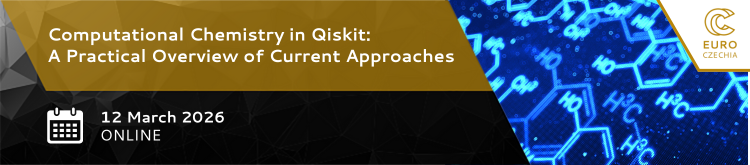
![[ONLINE] Computational Chemistry in Qiskit: A Practical Overview of Current Approaches](/event/380/logo-3264908871.png)
Annotation
Computational chemistry is among the most resource-intensive domains in high-performance computing, making it a natural frontier for quantum and hybrid quantum–classical algorithms. This training session will introduce the most discussed quantum algorithms for chemistry, highlighting their principles, practical implementations, and typical application areas. Through hands-on demonstrations using the Qiskit software development kit, participants will explore how methods such as VQE, QPE, and other variational or perturbative hybrids can be applied to molecular problems. Particular attention will be given to the scaling of quantum and classical resource requirements, current hardware limitations, and the practical usability of these approaches in real-world chemical simulations.
Benefits for the attendees: what will they learn
Participants will gain a clear overview of the current landscape of quantum and hybrid algorithms for computational chemistry, including practical examples of how these methods are applied. They will also learn to critically assess the feasibility, resource requirements, and real-world usability of these approaches.
Level
Intermediate
Language
English
Prerequisites
Basic knowledge of Qiskit, computational chemistry, and quantum computing.
Technical requirements
Installed libraries according to the announcement one week prior to the training.
Tutor
Michal Belina is a postdoctoral researcher at the Quantum Computing Laboratory within the IT4Innovations National Supercomputing Center. He earned his Ph.D. in computational chemistry from the University of Chemistry and Technology in Prague. His doctoral work focused on modelling relaxation processes following electronic excitation or ionisation, including core-level ionisation. He is focused on hydrogen-bonded systems ranging from several atoms to crystal structures, with periodic boundary conditions.
Acknowledgements

This project has received funding from the European High-Performance Computing Joint Undertaking (JU) under grant agreement No 101101903. The JU receives support from the Digital Europe Programme and Germany, Bulgaria, Austria, Croatia, Cyprus, Czech Republic, Denmark, Estonia, Finland, Greece, Hungary, Ireland, Italy, Lithuania, Latvia, Poland, Portugal, Romania, Slovenia, Spain, Sweden, France, Netherlands, Belgium, Luxembourg, Slovakia, Norway, Türkiye, Republic of North Macedonia, Iceland, Montenegro, Serbia. This project has received funding from the Ministry of Education, Youth and Sports of the Czech Republic.
.png)

This course was supported by the Ministry of Education, Youth and Sports of the Czech Republic through the e-INFRA CZ (ID:90254).
All presentations and educational materials of this course are provided under the Creative Commons Attribution-ShareAlike 4.0 International (CC BY-SA 4.0) license.